
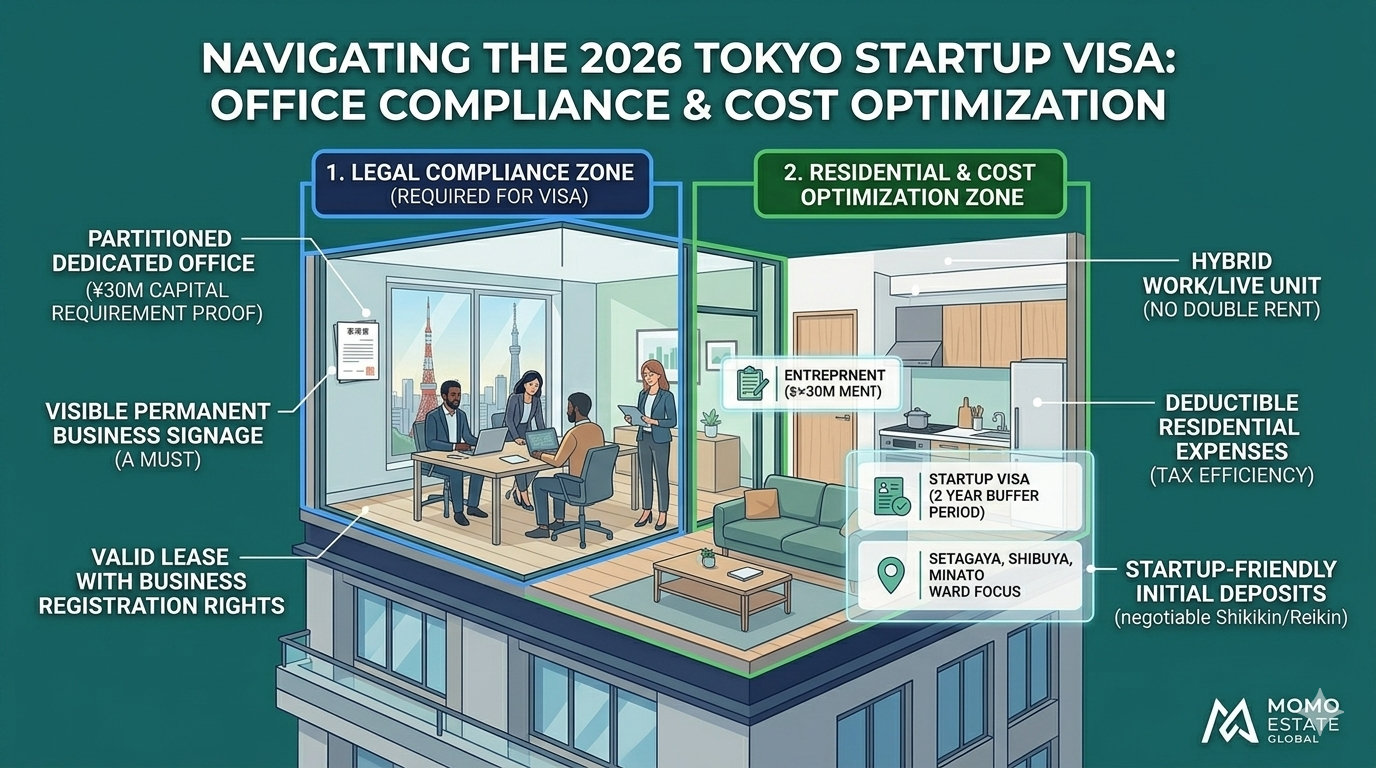
Navigating the 2026 Tokyo Startup visa
The year 2026 marks a revolutionary turning point for Japan’s startup ecosystem. With the government’s Startup Island Japan initiative in full swing, Tokyo has become a beacon for global founders. However, the path to residency and operational success has significantly narrowed due to the landmark October 2025 Visa Reform.
For foreign entrepreneurs, the challenge is no longer just finding a desk. It is about securing a space that satisfies strict legal scrutiny while maintaining a lean budget in a high-cost market. This guide breaks down the essential strategy for renting a startup office in Tokyo in 2026.
1. The new legal landscape: Why your choice of office matters
Gone are the days when a simple shared desk or a virtual address could secure a Business Manager Visa. Following the 2025 reforms, the Immigration Services Agency (ISA) has heightened its standards for physical business premises.
The “Virtual Office” ban: Virtual offices or nominal addresses are now strictly prohibited for Business Manager Visa applications. Your office must be an independent physical space.
Physical segregation: If you are renting a shared space or a SOHO (Small Office/Home Office), the business area must be clearly partitioned. It needs its own entrance, a dedicated desk, and a permanent company sign.
The “One year buffer”: Fortunately, the 2026 Startup Visa offers a lifeline. It allows founders to enter Japan for up to two years without meeting the full office or capital requirements immediately, giving you time to scout for the perfect location while living in the country.
2. Strategic locations: Where to plant your flag in 2026
Location in Tokyo is not just about rent; it is about credibility. Your ward defines your brand.
– Shibuya: The IT & AI Powerhouse
Shibuya remains the undisputed heart of Japan’s tech scene. In 2026, the “Shibuya Startup Support” programs provide deep subsidies for international founders. If your startup is in AI, SaaS, or Fintech, Shibuya is the place to be—but expect high competition and premium rents.
– Setagaya & Meguro: The creative frontier
For media, fashion, and lifestyle startups, these wards offer a more “human” aesthetic. Setagaya, in particular, has become a hub for SOHO buildings that blend high-end design with functional office space. It is often more cost-effective than central Minato while offering a sophisticated brand image.
– Taito & Sumida: Logistics & Tourism
If your business involves physical goods, e-commerce, or tourism, these eastern wards offer larger floor plates and proximity to major transport hubs like Ueno, often at 30% lower rent than the western wards.
3. Financial realities: The cost of entry
Renting commercial space in Tokyo involves high initial hurdles. In 2026, the average fit-out cost for a hybrid workplace in Tokyo has reached approximately ¥1.2 million per tsubo (3.3 sqm).
Shikikin (Security deposit): Traditionally 6–10 months. However, many “startup-friendly” landlords now offer 2–3 months’ deposit in exchange for using a guarantor company.
Reikin (Key money): Increasingly rare in the commercial sector, but still present in SOHO apartments. Always aim to negotiate this to zero.
The ¥30M capital requirement: For a full Business Manager Visa, you must now show ¥30 million in capital or investment. Smart founders allocate a portion of this to “office infrastructure” to prove to immigration that the business is substantive.
4. Case study: Maximizing the SOHO Strategy
The most successful foreign founders in 2026 are utilizing the SOHO (Small Office Home Office) model.
Imagine a founder launching a creative tech agency. By renting a SOHO in Setagaya, they can legally register their business and live in the same building.
Cost savings: No double rent (home + office).
Tax efficiency: A portion of the rent and utilities becomes a deductible business expense.
Compliance: As long as there is a clear “business zone,” the ISA will approve the visa.
5. Essential checklist for 2026 office hunting
Before signing a lease, ensure these boxes are checked:
[ ] Business Registration Rights: Does the contract explicitly state the tenant can register a Kabushiki Kaisha (KK) or Godo Kaisha (GK) at this address?
[ ] Signage Rights: Can you place a company plaque at the entrance? (A must for Visa approval).
[ ] Connectivity: In 2026, 6G and fiber-optic readiness are standard expectations. Check the building’s backbone.
[ ] Guarantor Companies: Ensure the landlord accepts foreign-owned entities with a guarantor company like Global Trust Networks (GTN).
Conclusion: Beyond the lease
Renting an office in Tokyo is the physical manifestation of your startup’s commitment to the Japanese market. While the 2025 reforms raised the bar, the rewards for those who navigate the system are immense. Japan’s market is hungry for international innovation, and your office address is your first handshake with the local business community.
At Momo Estate, we specialize in bridging the gap between foreign ambition and Japanese real estate reality. Whether you are a solo founder on a Startup Visa or a scaling tech firm, finding a space that is “Visa-Ready” and “Budget-Smart” is our mission.