
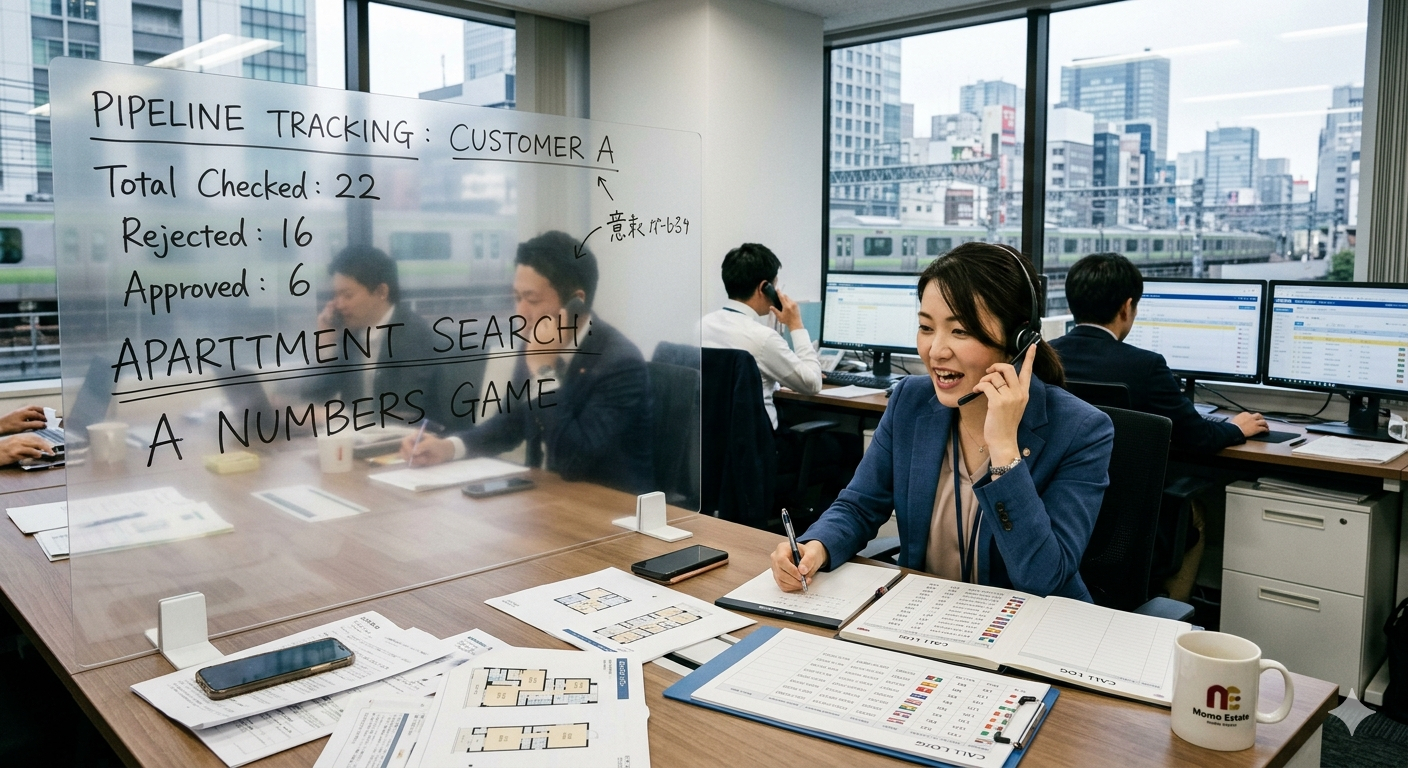
The foreigner screening filter: Why getting approved in Japan is a numbers game
If you are a foreign national looking for an apartment for rent in Japan, you may have already experienced one of the most frustrating aspects of the relocation process. You have found a gorgeous apartment online, within your budget and close to a major train line. Your documentation is pristine, your salary is stable and you are ready to pay the initial move-in costs upfront. Yet, before you can even schedule a viewing, your real estate agent calls back with a familiar phrase: “Sumimasen, the landlord is not accepting foreign tenants at this time.”
At Momo Estate, we believe in radical transparency. Hearing that an application cannot move forward hurts, and it is easy to take it personally. However, navigating the Japan housing market successfully requires a change in perspective. Renting an apartment here as an expat is not an emotional hurdle—it is a numbers game.
Once you understand how the foreigner screening filter works behind the scenes, you can stop feeling discouraged and start using the data to your financial and practical advantage.
The reality of the Gaijin filter by the numbers
Let’s look at the hard truth of the Tokyo rental market. Statistically, when a real estate agent searches the central database for properties, a vast portion of traditional Japanese landlords are hesitant to lease to non-Japanese residents.
[Total Available Market]        │
       ▼
[Filter 1: Landlord Approval] ──► Reduces pool by ~50% to 70%       │
       ▼
[Filter 2: Guarantor Company Vetting] ──► Strict income & visa rules       │
       ▼
[Your Approved Properties] ──► The actionable numbers game
Depending on the neighborhood, building age, and management structure, between 50% and 70% of standard rental properties are effectively filtered out immediately based solely on nationality or language barriers. This initial rejection has nothing to do with you as an individual; it is an automated, systemic gatekeeping mechanism.
If your agent calls 10 landlords, it is completely normal for 6 or 7 of them to say “no” right away. Recognizing this upfront is your secret weapon. If you assume that every listing you see online is available to you, your property search will be an emotional rollercoaster. If you know from day one that it is a strict volume game, you will approach the market with the strategic mindset needed to win.
Why landlords mostly block foreign applications
To bypass a filter, you must first understand why the filter exists. Japanese property owners and management companies prioritize extreme risk mitigation and long-term stability over maximizing quick rental yields. Their hesitation is rarely rooted in malice; it is driven by three distinct systemic anxieties:
1. The language and communication barrier
Real estate contracts in Japan are legally dense and binding. Landlords worry about day-to-day building operations:
What happens if there is a water leak or a kitchen fire and the tenant cannot communicate with emergency services?
How will building-wide maintenance announcements (like water shut-offs or elevator repairs) be communicated if the tenant cannot read Japanese?
2. Cultural anomalies & community rules
The most common friction points in Japanese neighborhoods involve community harmony:
Garbage sorting (Gomi Shubin): Japan’s trash disposal system is notoriously complex, requiring meticulous separation of burnable, non-burnable, plastics, and recyclables, all put out on specific days. Landlords fear complaints from neighbors or local government officials if a tenant fails to follow these rules.
Noise disruption: Many apartments in dense urban hubs like Tokyo feature thin walls. Cultural norms dictate a very quiet living environment, particularly after 9:00 PM.
3. The midnight run risk
Because Japanese law heavily protects tenant rights, evicting someone who stops paying rent is an incredibly slow, expensive legal nightmare. Landlords harbor a fear that a foreign resident might suddenly lose their job, break their lease, leave their belongings behind, and return to their home country without settling their final bills or paying for room restoration.
How the screening process works
When you find a property that passes the initial landlord check, your profile must survive a formal two-step screening process (shinsa):
Step 1: The Institutional Guarantor Company Vetting (Hoshonin Kaisha)                     │
                          ▼
Step 2: The Individual Landlord / Management Company Review
Hurdle 1: The guarantor company (Hoshonin Kaisha)
Because traditional personal guarantors are difficult for expats to secure, modern contracts utilize a rent guarantee company. They review your application mathematically:
The 33% solvency rule: Your gross monthly income must comfortably equal at least three times the monthly rent. If the rent is ¥120,000, your verifiable monthly income needs to be at least ¥360,000.
Visa longevity: They look closely at your residence card. If you have a 1-year visa but apply for a 2-year standard lease, it flags the system as higher risk.
Hurdle 2: The landlord’s final review
Once the guarantor company approves your financial solvency, the application goes back to the owner. They look at stability metrics: your industry, company reputation, length of employment, and your real estate agent’s evaluation of your character and Japanese language ability.
4 strategic plays to win the numbers game
Now that you know the exact layout of the board, here is how you and your real estate agency can optimize your profile to guarantee an approval:
1. Stack your pipeline
Do not fall in love with a single online listing. Work with your agent to select 8 to 12 properties that meet your physical criteria. Allow your agent to conduct an initial “foreigner check” phone sprint across all of them simultaneously. If 7 say no, you still have 3 to 5 viable apartments ready for viewings and immediate application.
2. Front load your financial transparency
When applying for an expat housing option, provide your documentation perfectly on day one. Have digital copies of your passport, Residence card (Zairyu Card), official employment contract with a clear salary breakdown, and your Japanese bank account details ready. A complete application shows the landlord that you are organized and reliable.
3. Ace the agent interview
Your real estate broker is your advocate. When an agent calls a landlord, they will say: “I am working with a wonderful client. They are polite, professional, and understand Japanese apartment etiquette.” Treat every interaction with your agency as a mini-interview; your professionalism gives your broker the confidence to pitch you aggressively to hesitant owners.
4. Target managed corporate properties
Independent, elderly landlords who own a single building tend to have more conservative screening standards. Conversely, large corporate real estate funds and modern developments are inherently numbers-driven. They use professional, multilingual property management services and view foreign professionals simply as reliable sources of rental income.
Partnering with Momo Estate
Renting an apartment in Japan doesn’t have to be a stressful trial of rejection. By looking at the property market through a data-driven lens, you can strip away the frustration and focus on the math that works.
At Momo Estate, we specialize in managing the numbers game for you. We know exactly which landlords welcome the international community, which guarantor companies offer streamlined screening for expats, and how to position your application for a fast, definitive “Yes.” Let us handle the filters so you can focus on making your new space feel like home.