
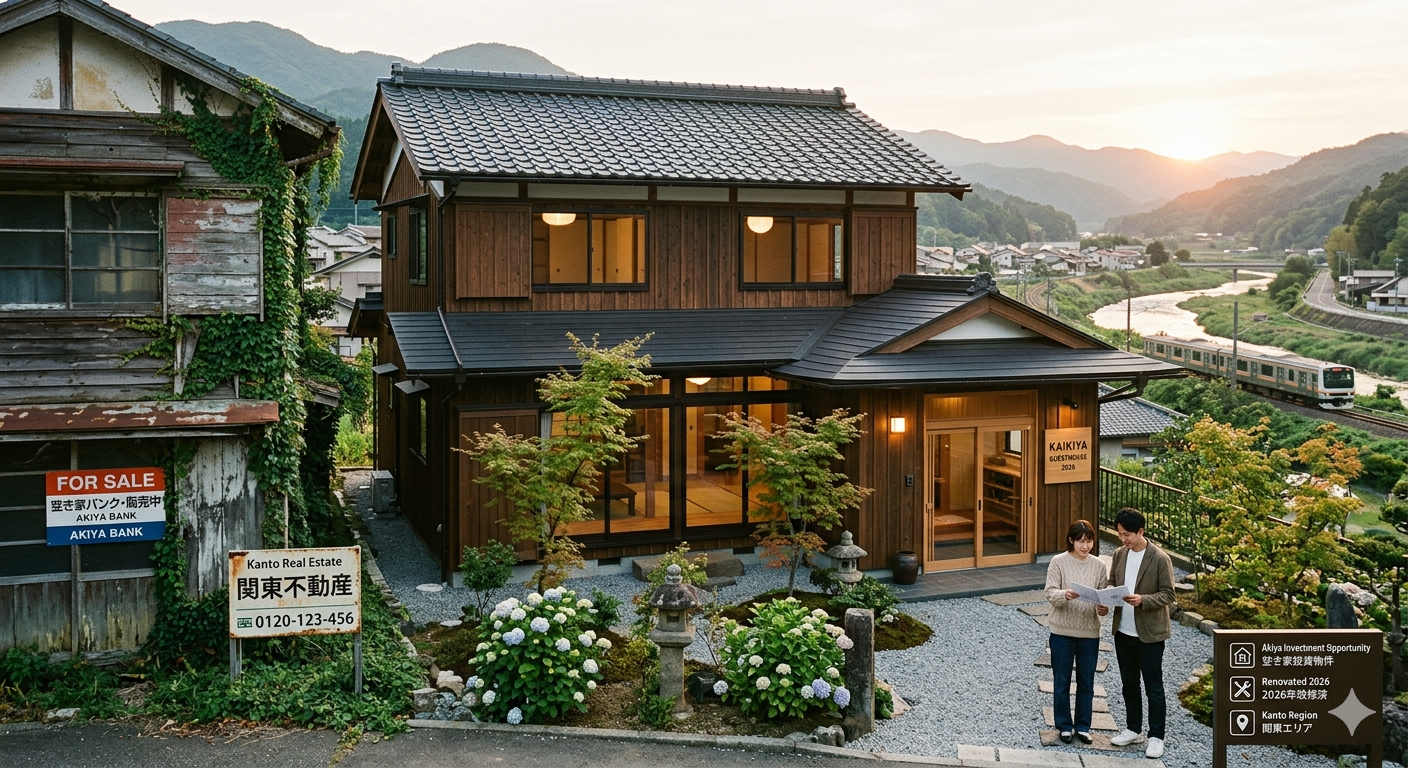
The ultimate guide to Akiya investment in Japan: Is 2026 the year to buy?
The Japanese real estate market is currently witnessing a phenomenon that has captured the attention of global investors and lifestyle seekers alike: the rise of the Akiya. As of early 2026, Japan’s vacant house crisis has reached a new peak, with over 9 million abandoned properties nationwide. While these homes represent a demographic challenge for the Japanese government, they present a unique high-yield opportunity for the savvy real estate investor.
In this article, we explore what Akiya are, the specific opportunities within the Kanto region and the critical pros and cons of investing in Japanese abandoned homes from a professional financial perspective.
1. What is an Akiya?
The term Akiya (空き家) literally translates to empty house or vacant house. These are residential properties that have been abandoned or left vacant for extended periods, often due to Japan’s aging population and the migration of younger generations to urban centers.
Historically, many Akiya were found in deep rural areas. However in 2026, the definition has expanded. We are now seeing urban Akiya—properties in the outskirts of major cities that are vacant because of complex inheritance laws or the high cost of demolition. For investors, the appeal lies in the price: some properties are listed on Akiya Banks for as little as ¥500,000 ($3,500 USD), while others are essentially free, provided the buyer assumes the back taxes and maintenance responsibilities.
2. Investing in the Kanto area
While rural Hokkaido or Shikoku offer the cheapest homes, the Kanto area (comprising Tokyo, Kanagawa, Chiba, Saitama, Gunma, Tochigi, Ibaraki) remains the most strategically viable for investment.
– Proximity to Tokyo
The Kanto region is home to the Tokyo metropolitan city, the world’s most populous metropolitan region. Investing in an Akiya in Chiba or Saitama allows you to acquire property at a fraction of central Tokyo prices while remaining within a 60–90 minute commute. In 2026, the trend of remote-hybrid work has sustained demand for larger and more affordable suburban homes.
– Tourism and short-term rentals (Minpaku)
Areas like Kanagawa (specifically near Hakone or Kamakura) and Chiba (near the coast) are prime locations for Minpaku (short-term rentals). A renovated Akiya converted into a traditional-modern hybrid guest house can yield significant returns, especially as Japan continues to break tourism records in 2026.
– Higher liquidity
Unlike a remote home in a depopulated village, an Akiya in Kanto is far easier to resell. The land value in the Kanto region has shown more resilience and growth compared to the national average, making it a safer land bank play.
3. Pros of Akiya investment (The ROI perspective)
Extremely low entry cost: You can purchase physical land and a structure for less than the price of a mid-sized sedan.
Government subsidies: In 2026, many local municipalities in Kanto offer renovation grants up to ¥2 million ($14,000 USD) to encourage the revitalization of these homes.
Full ownership for foreigners: Unlike many other Asian markets, Japan allows foreigners to own both the building and the land with no residency requirements.
Creative potential: From Hacker houses for tech nomads to boutique Airbnbs, the low cost of the shell allows for a high budget allocation toward high-end interior design and modernization.
4. Cons and risks: The Akiya trap
Renovation costs: A free house is never actually free. Many Akiya suffer from termite damage, mold and structural decay. Modernizing a 40-year-old home to meet 2026 earthquake standards can cost between ¥5 million and ¥15 million.
Property tax incentives (The demolition trap): Historically, Japanese law kept taxes low as long as a structure stood on the land. However, 2026 regulations have tightened, and owners of poorly maintained Akiya now face tax hikes if they do not renovate or demolish.
Limited financing: Most Japanese banks will not provide mortgages for old Akiya. This is almost exclusively a cash-buyer’s market.
Maintenance and neighbors: Japanese neighborhood associations (Chonaikai) are tight-knit. An abandoned-looking house can lead to friction with neighbors, requiring investors to be proactive about landscaping and external upkeep.
5. Is it worth investing in an Akiya in 2026?
The short answer: Yes, but only with a clear exit strategy.
If you are looking for a “fix-and-flip” for a quick profit, the Akiya market is likely too slow and bureaucratic for you. However, for long-term rental yields or lifestyle investments, the math is compelling.
The 2026 strategy for success:
Focus on location: Stick to the Kanto commuter belt or established tourist zones. Avoid “Genkai Shuraku” (marginal hamlets) where the population is rapidly disappearing.
Professional inspection: Always hire a licensed Japanese building inspector. Hidden costs like asbestos removal or pipe replacement can turn a bargain into a liability.
The “Third Way”: Many investors are now using Akiya as satellite offices or creative studios, tapping into the growing community of digital nomads in Japan.
6. Conclusion
Akiya investment in Japan is no longer just a niche hobby for Japanophiles. It is a legitimate asset class in 2026. By focusing on the Kanto region, leveraging government grants, and budgeting strictly for high-quality renovations, investors can secure a piece of Japanese real estate that offers both cultural value and a steady cap rate.