
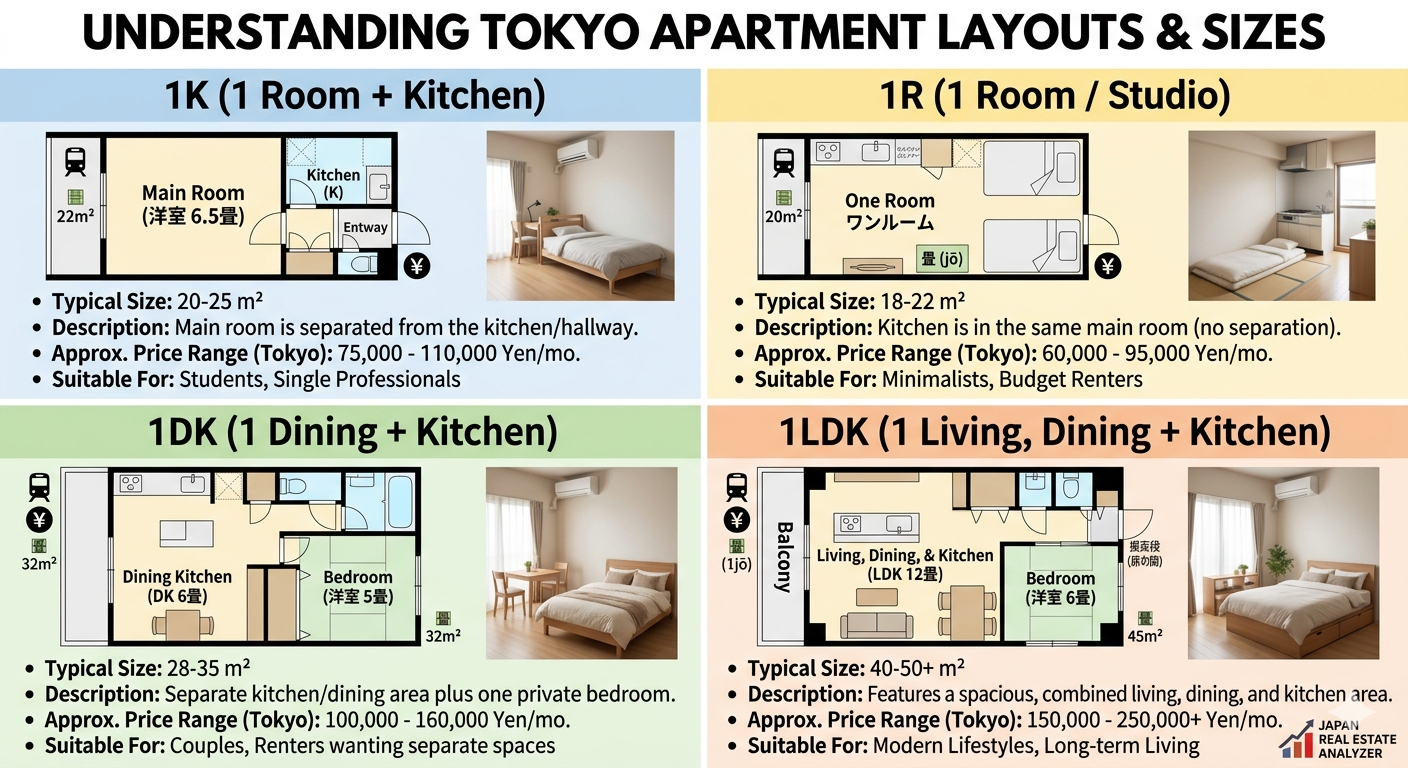
Tokyo apartment layouts: Size and price
Navigating the Tokyo rental market is a formidable challenge for expatriates and locals alike. In a city where space is the ultimate luxury, understanding the nuanced terminology of Japanese apartment layouts is essential for making an informed decision. Central to this understanding are the acronyms 1K, 1DK, and 1LDK. While they may appear similar at a glance, the differences in floor area, lifestyle functionality, and monthly cost are significant.
The Anatomy of Tokyo apartment layouts
In Japan, apartment types are categorized by the number of bedrooms followed by letter codes: R (Room), K (Kitchen), D (Dining), and L (Living). For those seeking a “one-bedroom” experience, the market primarily bifurcates into three paths, each governed by strict real estate labeling standards.
1. The 1K layout: The efficient professional standard
The 1K stands for “One Room + Kitchen”. Unlike the 1R (Studio), a 1K features a physical wall or door that separates the kitchenette from the living quarters. This separation is highly valued for containing cooking odors and providing a psychological barrier between “work” and “rest”.
Average size: Typically spans between 18m2 and 25m2.
Main room: Usually measures about 6 to 8 jo (tatami mats).
Best for: Single professionals who require a streamlined, easy-to-maintain home base.
2. The 1DK layout: The classic mid-sized hybrid
The 1DK (One bedroom + Dining Kitchen) offers a distinct step up in functionality. The “Dining” aspect implies a space large enough for a small dining table and chairs, separate from the bedroom. These are abundant in “mansion” style buildings in residential wards like Bunkyo and Setagaya.
Average size: Typically ranges from 25m2 to 35m2.
Dining/Kitchen area: Legally defined as being between 4.5 and 8 jo.
Best for: Renters who prefer not to eat in the same room where they sleep without paying the premium of a full living room.
3. The 1LDK layout: The modern urban sanctuary
The 1LDK (One bedroom + Living Dining Kitchen) is the most sought-after layout for modern city dwellers. By definition, an LDK space must be 8 jo or larger. This creates a “true” living room environment for a sofa, television unit, and dining set.
Average size: Spanning 35m2 to 50m2.
Modern features: In 2026, many new developments include “smart home” features and floor-to-ceiling windows.
Best for: Young couples or individuals with high-end remote work requirements.
2026 Tokyo rental market analysis: Price and location
Pricing in Tokyo is driven by proximity to the Yamanote Line, the age of the building, and the specific ward. Below is a breakdown of expected monthly rents in 2026:
| Layout | Avg. Size | Central (Minato/Shibuya) | Residential (Setagaya/Suginami) | Peripheral (Adachi/Edogawa) |
| 1K | 20-25m2 | ¥125,000
| ¥95,000
| ¥70,000
|
| 1DK | 28-35m2 | ¥165,000
| ¥125,000
| ¥90,000
|
| 1LDK | 38-50m2 | ¥260,000
| ¥175,000
| ¥130,000
|
Strategic renting advice
If your budget is fixed at ¥140,000, you face a strategic choice in 2026: a high-end 1K in the heart of Roppongi, a spacious 1DK in Nakano, or a brand new 1LDK in the farther reaches of Chiba or Saitama. Most Tokyo residents prioritize station distance over total square footage.
Note on storage: In Japan, built-in storage (closets) is included in the total area. Furthermore, 1K units often use a “unit bath” (all-in-one), while 1LDKs typically feature a “separated toilet and bath,” which significantly impacts property valuation.
Conclusion
Choosing between these layouts is a trade-off between lifestyle and geography. The 1K offers efficiency, the 1DK provides a balance of utility, and the 1LDK serves as a social hub or sanctuary. As Tokyo continues to evolve in 2026, these layouts remain the fundamental building blocks of the city.
Check out our property list to find your dream house!