
Tokyo neighborhood guide: Why Suginami is the smart choice for expats and international residents in 2026
There is a certain type of foreigner who moves to Tokyo and eventually leaves the obvious neighborhoods behind. They start in Shinjuku or Shibuya, drawn in by the energy, the convenience, the sense of being at the center of everything. Then, after a year or two, they quietly relocate west. They end up in Suginami Ward (杉並区) — and they stop moving.
That pattern says everything you need to know about this ward.
Suginami is not a neighborhood that announces itself. It does not have a skyline or a famous landmark that ends up on postcards. What it has is something harder to manufacture: genuine residential character, cultural depth, and an exceptional quality of daily life that makes long-term living in Tokyo feel sustainable rather than exhausting. For international residents, expat families, and remote professionals evaluating the Tokyo rental market in 2026, Suginami deserves to be at the top of the shortlist.
Where is Suginami Ward, and who lives there?
Suginami is located in western Tokyo, directly bordering Shinjuku and Nakano to the east, Nerima to the north, and Setagaya and Mitaka to the south. It covers roughly 34 square kilometers and is home to approximately 580,000 residents.
The ward’s population skews toward creative professionals, academics, long-term Tokyo residents, and increasingly, international workers and families who prioritize livability over postcode prestige. Suginami offers a unique cultural bridge that delivers both urban accessibility and peaceful residential character, a combination that is genuinely difficult to find anywhere else in the 23 wards.
The Suginami real estate market in 2026
Suginami sits in the middle-ring of Tokyo’s ward hierarchy — not as expensive as Minato or Shibuya, not as peripheral as Adachi or Katsushika, and significantly better connected than its rents would suggest.
Suginami Ward rental prices are forecast to rise from ¥3,369/m² to ¥3,508/m² by Q1 2027, reflecting steady, sustainable appreciation rather than speculative volatility. That growth is backed by fundamentals: high demand, limited supply, and a ward that has consistently attracted quality tenants.
Typical rental price ranges in Suginami (2026):
- 1K / 1R (singles, students): ¥65,000 – ¥90,000/month
- 1LDK (couples, solo professionals): ¥110,000 – ¥160,000/month
- 2LDK (small families, home office setups): ¥170,000 – ¥250,000/month
- 3LDK / detached houses (一戸建て): ¥250,000 – ¥380,000+/month
For buyers, the average price for a pre-owned 70m² condominium in Suginami is approximately ¥68,900,000 as of 2026, reflecting healthy annual appreciation of about 3.5%. Investment-wise, the ward posted a land price gain of 15.1% in the most recent cycle, with rental yields ranging from 4% to 6% — making it one of the more compelling mid-tier investment destinations in Tokyo right now.
Transport access: The Chuo Line advantage
Suginami’s backbone is the JR Chuo Line, one of Tokyo’s fastest and most direct arteries. From stations like Koenji, Asagaya, or Ogikubo, central Tokyo is close:
- Shinjuku: 12–18 minutes
- Tokyo Station: 25–35 minutes
- Akihabara / Ochanomizu: 20–30 minutes
Beyond the Chuo Line, Suginami is served by the Chuo-Sobu Line (local service, additional stops), the Marunouchi Subway Line (running through Ogikubo, connecting to the heart of the city), and the Keio Inokashira Line in the southern section of the ward connecting to Shibuya.
The result is a ward where a 15–25 minute commute to most of Tokyo’s major business districts is entirely realistic — at rents that are 15–20% lower than comparable units closer to the city center. For professionals doing the math on Tokyo housing costs, Suginami repeatedly comes out ahead.
Sub-areas to know: Suginami’s distinct neighborhoods
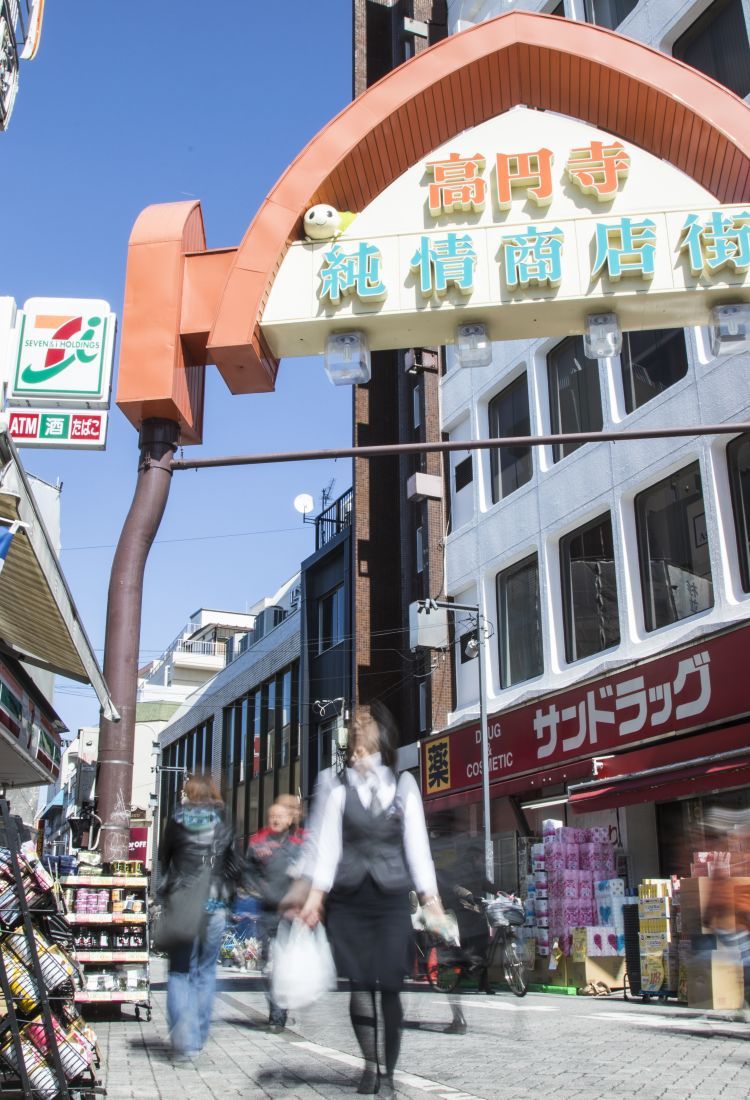
Koenji (高円寺) is arguably the most distinctive neighborhood in all of western Tokyo. It has a long-standing reputation as the city’s subculture capital — a dense commercial district packed with vintage clothing stores, live music venues, independent bookshops, curry restaurants, and kissaten (old-school Japanese coffee shops) that have survived decades of Tokyo’s relentless commercial churn. Koenji has an unmistakably analog energy in a city that often feels overwhelmingly digital. For creative professionals, musicians, writers, or anyone who values neighborhood character over polish, Koenji is in a class of its own.
Asagaya (阿佐ヶ谷) is Koenji’s quieter sibling — a neighborhood with its own strong local identity, a thriving jazz scene (the annual Asagaya Jazz Streets festival draws thousands every autumn), and one of the better covered shopping arcades in western Tokyo. The residential streets around Asagaya Station are calm and well-maintained, making it a solid choice for families or professionals who want proximity to Koenji’s energy without being inside it.
Ogikubo (荻窪) is Suginami’s most practically minded neighborhood and one of the best for foreigners setting up a Tokyo home from scratch. Ogikubo’s furniture district makes it particularly practical for those furnishing a new apartment — the area has a well-known concentration of antique and secondhand furniture dealers, which is exceptionally useful given Japan’s notoriously compact apartment sizes. Ogikubo also has a larger commercial district with supermarkets, restaurants, and daily amenities, and the Marunouchi Line connection here is a significant transport bonus.
Nishi-Ogikubo (西荻窪) deserves its own mention. Sandwiched between Ogikubo and Kichijoji (technically Musashino City, just past the ward border), Nishi-Ogikubo is a neighborhood of antique shops, independent galleries, slow-living cafés, and a fiercely local community. It has become a quiet favorite among Tokyo residents who want to be off the tourist trail but still within easy reach of the city.
Daily life infrastructure for international residents
Suginami’s infrastructure is designed to make everyone feel at home. Supermarkets like Seijo Ishii specialize in imported goods, making it easy to maintain a familiar diet while exploring local Japanese ingredients. Beyond grocery access, the ward has solid international resident infrastructure:
- English-friendly clinics and hospitals are available throughout the ward, particularly around Ogikubo and Koenji
- International school access: the ward is within reasonable commute range of several reputable international schools in western Tokyo and neighboring Musashino and Mitaka
- Ward office support: Suginami’s ward office provides multilingual guidance for residency registration, health insurance enrollment, and other bureaucratic necessities that can be daunting for new arrivals
- Community networks: active expat communities, international meetups, and language exchange groups are easy to find through neighborhood associations and online groups
Suginami has a moderate foreigner acceptance rate in the rental market — landlords in the ward have increasing experience with international tenants, and working with a bilingual agent significantly improves approval odds.
Why Suginami works for long-term Tokyo living
The core argument for Suginami is not one single feature — it is the coherence of everything together. You get genuine transport access without central Tokyo rents. You get neighborhood identity and cultural richness without tourist density. You get green space, quiet residential streets, and enough local commercial life to make daily errands enjoyable rather than functional.
Whether you are a growing family, a creative professional, or a long-term expat looking for a real home in Tokyo, Suginami provides an ideal mix of affordability, livability, and character. It is not a ward for people passing through. It is a ward for people who intend to stay.
Ready to find your home in Suginami?
At Momo Estate, our bilingual team helps international residents navigate the Tokyo rental and real estate market with clarity and confidence — from initial property search through contract signing and move-in. Whether you are relocating for work, moving your family to Japan, or building a long-term investment portfolio in Kanto, we are here at every step.
📩 Contact us today to arrange your private consultation and explore available listings in Suginami and across Tokyo.
Phone: 03-6820-6203 | Email: info@momoestate.jp | Languages supported: EN / VI / JP