
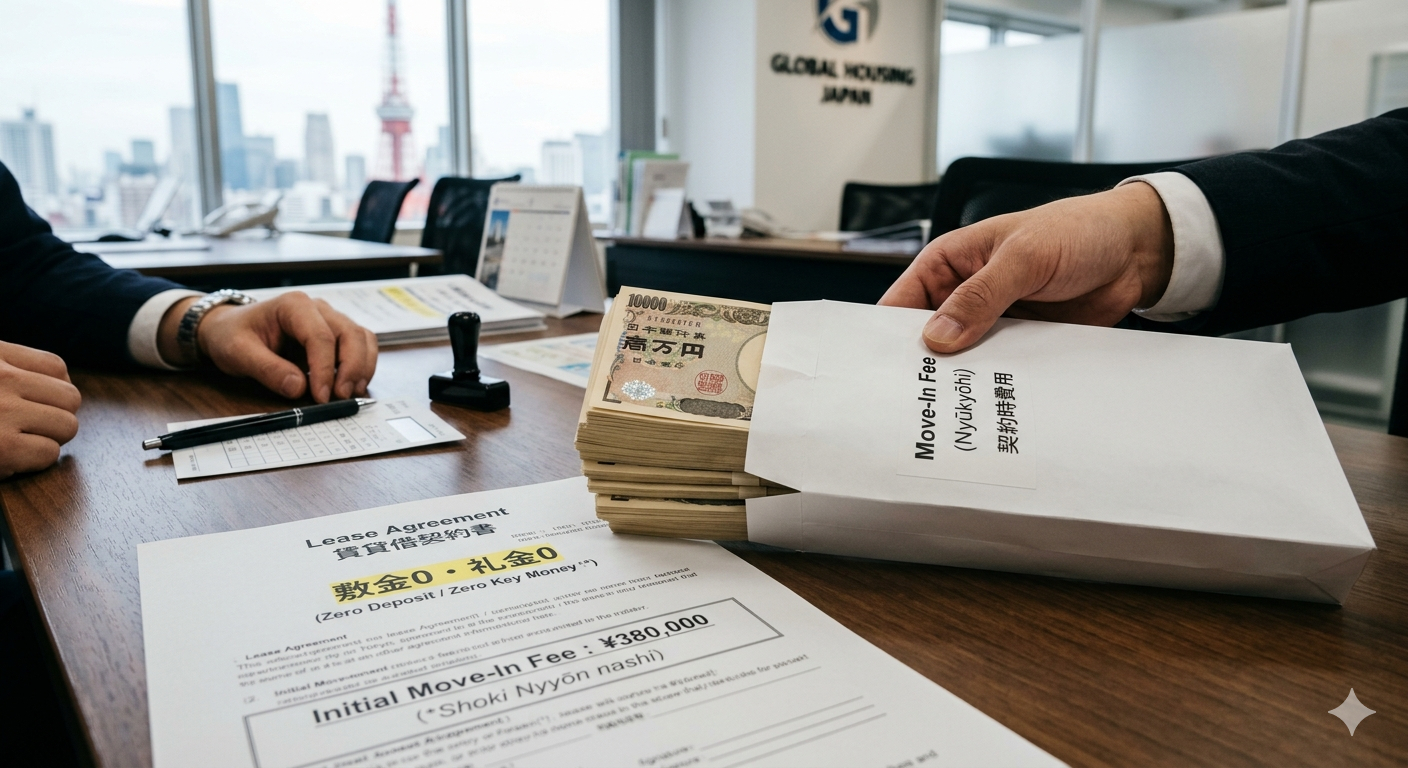
Understanding hidden move-in fees while renting apartments in Japan
When searching for apartments for rent in Japan, finding a listing that boasts zero deposit (shikikin) and zero key money (reikin) feels like winning the lottery. Upfront costs in Japanese real estate can be notoriously high, often requiring four to six months of rent before you even get the keys. For expats, students and young professionals looking to move to Tokyo or other major cities, skipping these two massive expenses sounds like the ultimate budget-saver.
However, many renters face a sudden shock when they receive the final initial cost breakdown. Even without the traditional shikikin and reikin, the total invoice can still feature a surprisingly heavy move-in fee or a bundle of mandatory contract charges required to secure the deal.
If you are navigating the Japan housing market, it is crucial to understand that real estate math always balances out. Here is an honest, transparent breakdown of why these tough upfront fees exist, what they actually cover, and how to evaluate if a “zero-zero” property is truly the best financial choice for you.
Why do “Zero-Zero” apartments have high upfront fees?
In the competitive Japanese rental market, landlords use zero deposit, zero key money promotions as a powerful marketing tool to attract tenants quickly, especially for vacant properties or during the off-peak moving seasons. However, real estate operates on risk management and cost recovery.
When a landlord waives traditional fees, they face two distinct challenges:
Higher risk: They have no financial cushion (the deposit) if a tenant damages the property or breaks the lease early.
Immediate costs: Preparing a room for a new tenant, registering contracts, and paying administrative costs still require capital.
To offset this risk, the initial financial structure is simply shifted. Instead of paying standard, explicitly labeled shikikin and reikin, the costs are restructured into non-refundable upfront rental fees and mandatory property management services. The marketing headline changes, but the necessity of securing the transaction remains.
The anatomy of a Japanese move-in fee breakdown
When you apply for a cheap apartment in Japan that waives standard deposits, your real estate agent will present an itemized invoice for the total initial cost (gokei shoki hiyou). You will typically see a combination of the following items bundled together to form that tough and unnegotiable move-in fee:
| Fee name (English & Japanese) | Average cost matrix | What it covers & why it is mandatory |
Guarantor company fee (Hoshonin Kaisha Hiyou) | 50% to 100% of one month’s rent | Essential for zero-deposit properties. Because there is no deposit to pull from if rent is missed, landlords require a third-party institutional guarantor to secure the lease. |
Lock changing fee (Kagi Kōkan Dai) | ¥15,000 to ¥33,000 | The physical cost of replacing the cylinder and issuing new high-security keys to ensure safety from previous occupants. |
Pest control & sanitization (Shōdoku Kōji Dai) | ¥15,000 to ¥25,000 | A mandatory chemical treatment performed before move-in to ensure the apartment is completely insect-free and sanitized. |
Real estate agency commission (Chūkai Tesūryō) | 0.5 to 1 month’s rent (+ tax) | The legal fee paid to the bilingual real estate agency or broker for sourcing the property, arranging viewings, and executing the legal contract. |
Fire and liability insurance (Kasai Hoken) | ¥15,000 to ¥25,000 (for 2 years) | Mandatory renter’s insurance protecting the building against accidental water damage, fire, or natural disasters. |
24/7 Property support fee (Anshin Sakōto) | ¥10,000 to ¥20,000 | A subscription fee for an emergency helpline that handles lockouts, plumbing issues, or late-night building emergencies. |
Prepaid rent & maintenance (Maechin / Kyōdaibi) | Pro-rated current month + next full month | Standard practice across all apartments for rent in Japan to ensure your housing account stays ahead. |
Is a Zero-Zero apartment still a good deal?
The Golden rule of Japan real estate: Always judge a property by its total upfront execution cost, never by the marketing labels alone.
An apartment requiring a steep initial move-in fee is not a scam or a deceptive practice; it is simply an alternative financial model. To know if it suits your specific situation, you have to weigh the pros and cons based on your planned length of stay.
The advantages
Lower capital barrier: You do not need to have a massive lump sum of savings (often equivalent to half a year’s rent) readily available to secure a contract.
Speed and accessibility: These properties are often managed by companies that streamline applications, making them highly popular options for foreigners moving to Japan who need housing approved quickly.
The disadvantages
Zero refund potential: Traditional deposit (shikikin) acts as a security pool. If you take immaculate care of the apartment, a portion of that deposit is legally returned to you when you move out. Conversely, move-in fees, cleaning fees, and guarantor fees are entirely non-refundable.
Hidden long term costs: Sometimes, zero-zero apartments carry a slightly higher monthly rent or higher renewal fees (koshinryo) every two years to compensate the landlord over time.
Expert advice for renting in Japan: How to avoid surprises
If you are currently browsing online real estate portals or working with a Tokyo real estate agent, use these strategic steps to protect your budget:
Request the total initial cost estimate early: Do not wait until the day of signing to see the invoice. Ask your agent for the goki shoki hiyou sheet before submitting your official application (moushikomi). At Momo Estate, we always give you a clear insight of your initial fee to make sure you feel transparent and comfortable during the process.
Clarify move-out fees in advance: If you pay an upfront cleaning fee now, clarify in writing whether you will be charged another cleaning fee when you vacate the premises.
Compare the total cost of occupancy: Calculate the cost of the apartment over the entire span of your visa or contract. Multiply the monthly rent by 24 months, add the upfront move-in fees, and compare that grand total against a traditional apartment that charges a deposit but has lower monthly rent.
Understanding how the Japan housing market operates behind the scenes allows you to make an informed, stress-free decision. By budgeting for a tough move-in fee from the start, you can secure your ideal apartment smoothly without any unexpected financial roadblocks.