
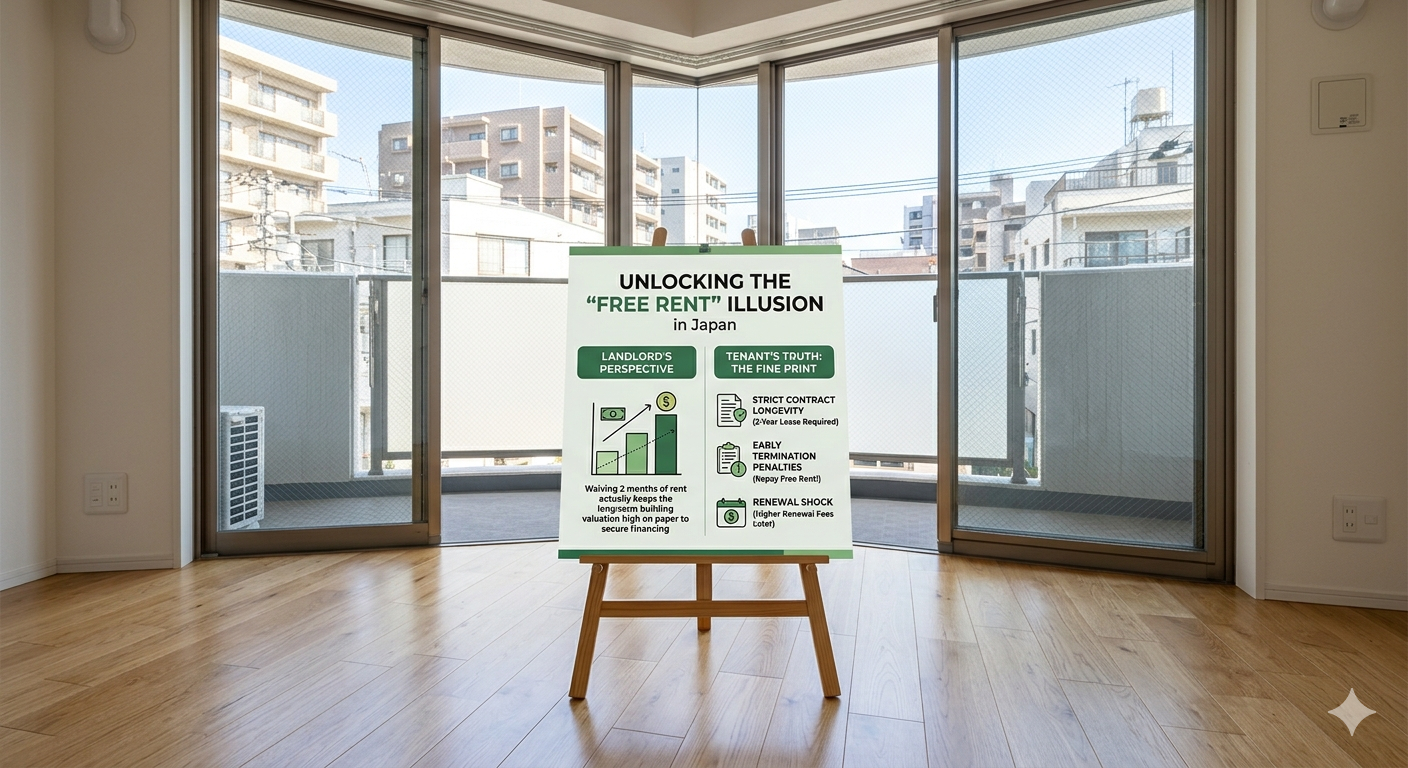
What’s the catch behind 1-3 months of free rent?
When browsing real estate portals for apartments for rent in Tokyo, few phrases catch the eye faster than “1 Month Free Rent” or “Up to 3 Months Free Rent!”
For anyone looking to minimize the notoriously high upfront costs of Japanese real estate, this sounds like an absolute lifesaver. It feels like a premium discount handed directly to you by a generous property owner.
At Momo Estate, we believe that the best rental experience is one built on radical transparency. Real estate is fundamentally a business of long-term asset management, and landlords rarely give away hundreds of thousands of yen without a structural strategy in place.
While a free rent campaign (furī rinto) can genuinely be a fantastic financial tool for the right tenant, it is rarely a pure, no-strings-attached gift. Here is the insider breakdown of how the free rent model operates behind the scenes in Japan, why landlords use it, and what you need to look out for before signing the lease agreement.
The landlord’s secret: Preserving the asset value
To understand the mechanics of a free rent campaign, you have to look at the property from the perspective of a corporate landlord or an institutional real estate investor.
When an apartment building sits vacant, the owner loses money every day. They need to attract tenants quickly, especially during the off-peak moving seasons. The most obvious solution would be to simply lower the monthly rent. For example, if a studio apartment isn’t renting at ¥100,000 per month, why not just lower it to ¥92,000?
Landlords resist lowering the official monthly rent for two massive structural reasons:
1. Bank valuation and re-selling power
The market valuation of a real estate asset in Japan is calculated largely based on its official yield projection—the raw monthly rent stated on the contracts. If a landlord drops the official rent of multiple units, the entire building’s paper value drops significantly. By keeping the rent at ¥100,000 but giving away the first month for free, the official yield remains high on paper, keeping banks and investors happy.
2. Tenant harmony & price protected rules
If a landlord permanently lowers the rent for a new tenant, existing tenants in the building who are paying the higher rate might find out. This often leads to awkward re-negotiation demands or complaints. Offering a “one-time move-in campaign” allows the landlord to lower the entry barrier for you without disrupting the payment ecosystem of the rest of the building.
The catch: Understanding the anatomy of a free rent contract
A free rent campaign is not a discount on your contract; it is a deferred payment structure tied to strict longevity clauses. When you sign a furī rinto agreement with a management company, it will almost always contain the following fine print:
1. The early termination penalty
This is the most critical catch. A free rent apartment is a loyalty program. The landlord is investing in you upfront, expecting to recoup that investment over a standard two-year lease.
If you break the lease early—usually defined as moving out within the first 12 to 24 months—you are hit with a mandatory penalty. This penalty is typically equivalent to the exact amount of free rent you received, plus an additional month’s rent as a standard breach of contract fee.
The reality check: If you take an apartment with 2 months of free rent but have to relocate due to a job change or family emergency 8 months later, you will have to pay back those 2 months entirely upon vacating.
2. The shifted initial fees
“Free rent” does not mean “free move-in.” Many tenants confuse a free rent campaign with a zero-cost initial invoice. Even if your first month of rent is waived, you are still legally required to pay the rest of the mandatory initial costs on day one. This includes:
The agency commission (Chūkai Tesūryō)
The guarantor company fee (often calculated based on the original un-discounted monthly rent)
Fire insurance and Lock changing fees
Prepaid maintenance fees (Kyōdaibi)
In some cases, landlords will waive the first month of base rent but still charge the monthly building maintenance fee for that exact same month.
3. The re-calculated renewal shock
In Japan, standard residential contracts are renewed every two years, accompanied by a renewal fee (kōshinryō), which is traditionally equivalent to one month’s rent.
When your contract comes up for renewal at the 24-month mark, your renewal fee will be calculated using the original, higher base rent, not a pro-rated average of what you experienced during your first year.
Case study: Doing the true-cost math
Let’s look at how the math balances out over a standard 24-month residential occupancy cycle. This comparison shows why looking at the long-term numbers is always safer than chasing a marketing headline.
| Financial metric | Option A: The free rent Illusion | Option B: The traditional stable rent |
| Advertised base rent | ¥110,000 / month | ¥100,000 / month |
| Campaign discount | 2 Months Free Rent (-¥220,000) | None |
| Actual rent paid (Yr 1) | ¥1,100,000 (10 months paid) | ¥1,200,000 (12 months paid) |
| Actual rent paid (Yr 2) | ¥1,320,000 (12 months paid) | ¥1,200,000 (12 months paid) |
| Total Rent Over 2 Years | ¥2,420,000 | ¥2,420,000 |
| Upcoming Renewal Fee | ¥110,000 | ¥100,000 |
As the table demonstrates, over a precise two-year timeline, both apartments cost the exact same amount of money. However, if you plan to stay in the apartment for a third or fourth year, Option A becomes significantly more expensive because you are locked into a higher baseline rate forever, and your subsequent contract renewal fees will remain elevated.
How to leverage free rent safely
Does the existence of these catches mean you should avoid free rent apartments entirely? Absolutely not. For specific profiles, these campaigns are exceptionally advantageous. You can safely win the game if you apply three strategic rules:
Lock in your timeline: Only apply for free rent properties if you are 100% certain that your employment status, visa longevity, and personal life will allow you to stay in the property for the full 24-month duration.
Use it for liquidity, not savings: Free rent is perfect if you have stable monthly income but your immediate cash reserves are tight due to flight costs, furniture shopping, or relocation expenses. It buys you a 30-to-90-day financial breathing room right after moving.
Check the management system: Always verify if the free rent applies to the first month of your occupancy or if it is applied retroactively to the second or third month of your contract.
Navigate the market strategically with Momo Estate
The Japanese rental market operates on subtle balances. When one cost is lowered, another is almost always adjusted elsewhere to manage risk.
At Momo Estate, we don’t just show you floor plans; we map out your total cost of occupancy across the entire lifecycle of your stay in Japan. We help you review the penalty clauses, negotiate terms with property management groups, and ensure that your “great deal” stays a great deal from the day you get your keys to the day you move out. Let us do the math so you can enjoy the move.