
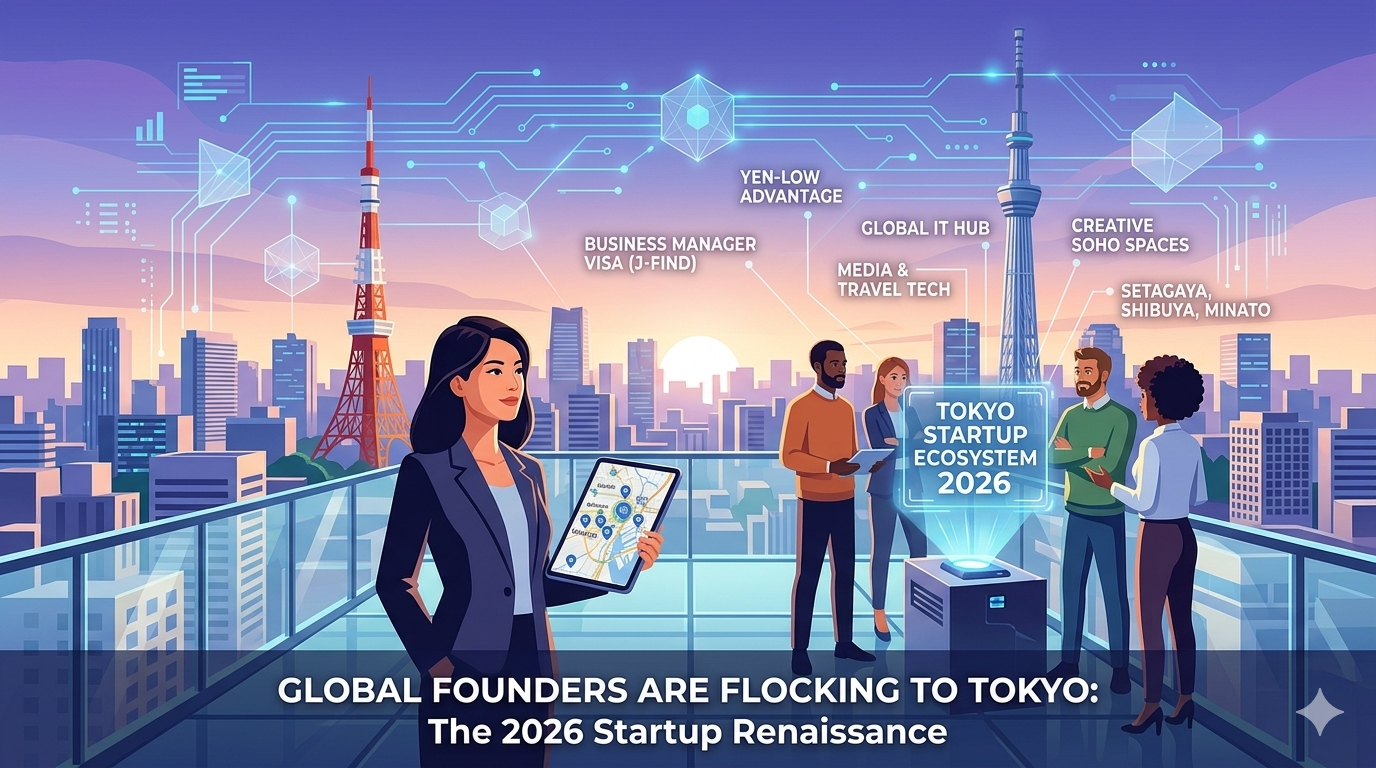
Why global founders are flocking to Tokyo: The 2026 startup renaissance
The global startup map is shifting. While traditional hubs like Silicon Valley and London face skyrocketing operational costs and market saturation, a new contender has emerged at the forefront of the innovation race: Tokyo, Japan. In 2026, the Japanese capital is no longer just a destination for corporate giants like Toyota or Sony. Instead, it has become a magnet for foreign entrepreneurs, digital nomads and venture capitalists. From the low Yen economic advantage to the government’s aggressive Startup Island Japan initiatives, Tokyo is undergoing a creative explosion.
Here is an in-depth look at why international founders are choosing Tokyo as their base of operations and how you can navigate this thriving ecosystem.
1. The economic catalyst: The Yen-low advantage
For years, Tokyo was synonymous with an expensive lifestyle. However, in 2026, the economic narrative has flipped. The sustained period of a competitive Japanese Yen has turned Tokyo into a cost-effective powerhouse.
For founders holding USD, EUR or GBP, their capital stretches significantly further in Japan than in almost any other G7 nation.
Operational runway: Seed funding that might last 12 months in the US can easily stretch to 24 months in Tokyo.
Talent acquisition: While local salaries are rising, the cost of hiring elite Japanese engineers and designers remains highly competitive on a global scale.
Quality of life: Founders can enjoy world-class infrastructure, safety, and cuisine at a fraction of the price of New York or Singapore.
2. Strategic visa reforms: The 2026 Business manager visa
The Japanese government has dismantled many of the bureaucratic “walls” that previously deterred foreign founders. The 2026 Business Manager Visa and the J-Find (Future Creation Individual Visa) have streamlined the residency process.
Previously, a physical office and 5 million JPY in capital were strict prerequisites before even stepping foot in the country. Today, the Startup Visa allows founders to reside in Japan for up to a year while they secure their office space and finalize their incorporation. This buffer period has been a game-changer for those needing to conduct local market research before committing heavy capital.
3. The rise of niche hubs
Tokyo’s startup scene is no longer a monolith. It has fractured into specialized neighborhoods, allowing founders to find a community that matches their industry “vibe.”
Shibuya & Minato (The tech Mecca): These wards are the epicenter of AI, SaaS, and Fintech. If you are looking for venture capital and high-speed networking, this is where you belong.
Setagaya & Meguro (Creative & lifestyle): These areas have become the go-to for Fashion-Tech, Media, and Sustainable Startups. The lifestyle-centric atmosphere attracts founders who value aesthetics and work-life harmony.
Taito & Sumida (Tourism & craft): With the 2026 tourism boom, founders in the travel-tech and hospitality sectors are revitalizing these historic districts, blending traditional Japanese “Monozukuri” (craftsmanship) with modern digital platforms.
4. Infrastructure & the smart city evolution
Tokyo is consistently ranked as one of the most livable cities in the world. In 2026, the city has doubled down on its Smart City initiatives.
Connectivity: 6G integration and ubiquitous public Wi-Fi make remote work seamless.
SOHO & Coworking culture: The real estate market has adapted. There is a surplus of SOHO (Small Office/Home Office) buildings specifically designed for foreign startups, offering English-language contracts and flexible lease terms—a service we specialize in at Momo Estate.
5. The “Made in Japan” impression
In the global market, a Tokyo-based headquarters carries an implicit stamp of quality, reliability, and sophistication. Whether you are developing a skincare line or a robotic automation tool, being “based in Tokyo” provides immediate brand equity. For foreign founders, tapping into the Japanese domestic market—the third-largest economy in the world—is a lucrative prospect, but using Tokyo as a springboard to the rest of Asia is the true strategic masterstroke.
6. Overcoming the language & real estate barrier
Despite the momentum, challenges remain. Language barriers and the “Galapagos Syndrome” (products developed solely for the Japanese market) are real hurdles. However, the ecosystem has matured to solve these:
Multilingual support: A new wave of “Startup Scriveners” and multilingual real estate consultants are bridging the gap.
Global outlook: Modern Japanese VCs are now actively seeking foreign-led startups to bring “disruptive thinking” into the local market.
Conclusion: Is Tokyo your next move?
The “Goldrush” to Tokyo is driven by a unique alignment of economic favorability and government support. It is a city where you can build a cutting-edge AI firm in the morning and retreat to a quiet, centuries-old shrine in the afternoon.
At Momo Estate, we have seen firsthand how the right location can transform a startup’s trajectory. Securing a compliant, stylish, and strategically located office is the first real step in turning your vision into a Tokyo reality.
Tokyo is calling. Are you ready to answer?
Summary Table: Tokyo Startup Hubs 2026
| Ward | Primary Industry | Vibe | Typical Rent (SOHO) |
| Shibuya | IT, AI, Fintech | High-energy, Fast-paced | ¥250k – ¥450k |
| Setagaya | Fashion, Media, Design | Sophisticated, Residential | ¥180k – ¥300k |
| Minato | Finance, Global Agencies | Corporate, Prestigious | ¥350k – ¥600k |
| Taito | Tourism, E-commerce | Historic, Creative | ¥140k – ¥220k |
Ready to find your base? Contact Momo Estate today for a curated list of startup-friendly properties.