
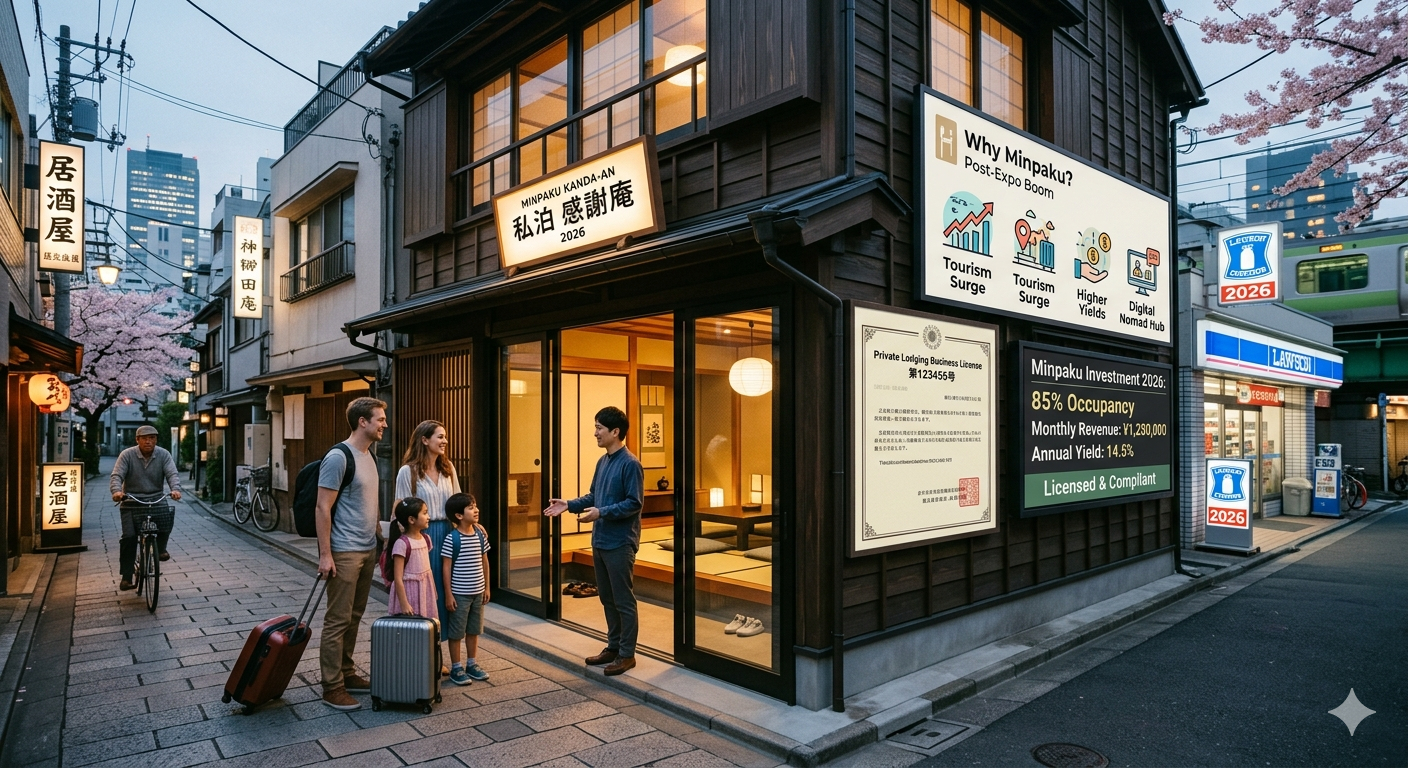
Why investing in Minpaku is a wise move in 2026
As we move through 2026, the landscape of global real estate investment has shifted toward markets that offer both stability and high-growth potential. In the heart of this shift is Japan’s Minpaku sector. While traditional long-term rentals in Tokyo and Osaka offer steady but modest yields, the short-term rental market has evolved into a sophisticated, high-return asset class.
Driven by record-breaking tourism numbers and a post-Expo 2025 economic ripple, here is why investing in Minpaku in 2026 is the smartest move for your portfolio.
1. The post-expo momentum and tourism surge
The 2025 World Expo in Osaka was more than just a six-month event, it was a catalyst for a permanent tourism boom. In early 2026, Japan is seeing a sustained influx of high-spending international travelers. Recent data suggests that visitors are no longer just visiting the “Golden Route” (Tokyo-Kyoto-Osaka); they are staying longer and seeking authentic, spacious accommodations that traditional hotels simply cannot provide.
Higher per-capita spending: International visitors in 2026 are spending significantly more than in previous years, with a growing preference for luxury and “experience-based” stays.
Capacity crunch: Despite new hotel openings, major cities are still facing a chronic shortage of family-sized rooms, making multi-bedroom Minpaku properties highly lucrative.
2. Superior yields: Minpaku vs. Long-term rentals
For investors, the most compelling argument is the ROI (Return on Investment). In 2026, the yield gap between short-term and long-term rentals has widened.
| Investment Type | Average Annual Yield (2026) | Primary Benefit |
| Traditional Long-Term | 3.5% – 5% | Hands-off, stable income |
| Minpaku (Standard) | 8% – 12% | High cash flow, flexible use |
| Minpaku (Prime/Luxury) | 15% – 20%+ | Massive upside in tourist hubs |
By operating a property under the Private lodging business act, owners can capitalize on nightly rates that often triple the monthly pro-rated income of a standard tenant. Even with the 180-day annual cap applied to standard Minpaku licenses, the revenue generated during peak seasons—such as Spring and Autumn—often exceeds a full year of traditional rent.
3. The rise of the Professional era (Regulatory clarity)
In years past, the Minpaku market was often criticized for being a gray market. However, by April 2026, new regulations have streamlined the industry. Stricter enforcement in wards like Sumida and Toshima has actually benefited serious investors by flushing out low-quality, illegal operators.
Today’s market is the “Compliance-First Era.” Having a clear legal framework means:
Reduced competition: Lower-quality unmanned rentals are being phased out due to new on-site management requirements.
Institutional trust: Banks and insurance companies are more willing to work with licensed Minpaku operators, providing better financial protection for your asset.
Market maturity: Professional management companies (PMOs) are now ubiquitous, allowing foreign investors to manage properties entirely remotely with high efficiency.
4. Strategic opportunities in the Kanto and Kansai regions
In 2026, location strategy has become more nuanced. Investors are finding hidden gems in the suburbs of major hubs.
The Kansai recovery: Osaka remains a powerhouse for Minpaku due to its Special Zone (Tokku) status, which allows for 365-day operation in certain districts. This removes the 180-day cap and effectively doubles the earning potential.
The Kanto expansion: In Tokyo, neighborhoods like Nakano and Setagaya are seeing a surge in lifestyle travelers who want a local experience. Additionally, properties near major transit hubs (like the Yamanote line) continue to maintain nearly 90% occupancy rates during peak months.
5. Asset appreciation and currency advantages
While the Japanese Yen has shown signs of stabilization in 2026, it remains competitively priced for those holding USD, EUR, or SGD. This “currency discount” allows international investors to acquire premium real estate at a lower cost basis.
Furthermore, unlike older Akiya in rural areas, urban Minpaku properties in Tokyo and Osaka are seeing steady land value appreciation. You aren’t just buying a cash-flow machine; you are holding a hard asset in one of the safest, most transparent legal systems in the world.
6. The “Digital nomad” and Flex-stay trend
A major shift in 2026 is the rise of the “middle-term” traveler. Digital nomads and remote workers are flocking to Japan, often booking stays of 2 to 4 weeks. Minpaku properties—equipped with kitchens, high-speed Wi-Fi, and laundry facilities—are the preferred choice for this demographic. This trend helps investors fill the “gap days” between short-term tourist bookings, ensuring a high occupancy rate year-round.
Is it the right time for you?
Investing in Minpaku in 2026 is no longer about getting lucky with a cheap apartment. It is about strategic hospitality. Success in today’s market requires:
Professional design: High-end interiors that stand out on booking platforms.
Strict compliance: Ensuring all fire safety and management licenses are up to date.
Local expertise: Partnering with managers who understand the specific “ward-level” ordinances.
Conclusion
With a compound annual growth rate (CAGR) for the Japanese short-term rental market projected at 13.4% through 2033, the window for early-mover advantage is still open. If you are looking for a high-yield, tangible asset in a country with booming tourism and a stable economy, 2026 is the year to enter the Japan Minpaku market.