
Yokohama for foreigners: The honest guide to living in Japan’s most international city in 2026
There is a version of the Tokyo relocation story that ends in Yokohama, and it is not the compromise version. It is the version where the person ran the numbers, looked at the commute honestly, and decided that 25 minutes on the Tokyu Toyoko Line is a reasonable price for an apartment that fits human furniture, a waterfront that looks like someone designed it on purpose, and a city that has been absorbing foreign residents for longer than Tokyo has been a metropolis.
Yokohama is Japan’s second-largest city and its most historically international. The port opened to foreign trade in 1859 and has never entirely closed. The result, a century and a half later, is a city with over 100,000 registered foreign residents, the country’s largest Chinatown, international schools that have operated for decades, hospitals with English-language support built into their standard intake process, and landlords who have been renting to foreigners long enough to have stopped treating it as unusual.
This is the guide for foreign residents considering Yokohama in 2026. The areas, the rent reality, the commute math, and what the city actually feels like to live in.
Why Yokohama works differently from Tokyo
The comparison that matters is not aesthetic — it is structural. Yokohama rents run approximately 13 to 20 percent lower than comparable Tokyo wards, and the city’s geography — organized around a clear waterfront, a central station, and distinct residential neighborhoods radiating outward — makes the apartment-hunting logic considerably more readable than Tokyo’s layered complexity.
A 1LDK in Minatomirai runs ¥190,000 to ¥350,000 per month for a premium waterfront unit. That same budget in the residential neighborhoods of Totsuka or Hodogaya finds a 2LDK with room to breathe. A 1K in the mid-range areas around Yokohama Station or Kannai runs ¥65,000 to ¥90,000 — which is cheaper than Shibuya and faster to central Tokyo than Nerima.
The commute question is the one most people ask first, and the honest answer is: it depends which Tokyo you need to reach. Minatomirai to Shibuya is 25 minutes on the Tokyu Toyoko Line, direct. Yokohama Station to Shinjuku is 30 minutes on the JR Shonan-Shinjuku Line. Yokohama to Tokyo Station runs 25 to 30 minutes on the Tokaido Line. These are not suburban-compromise numbers. For anyone whose work or daily life is in southern or western Tokyo, Yokohama is competitive with living inside the city.
For anyone whose work is in Yokohama itself — and a significant international business presence including Nissan’s global headquarters, Fujitsu, and a dense concentration of logistics and port-related industry makes this a real category — the commute question disappears entirely.
The main areas for foreign residents in 2026
Minatomirai みなとみらい — The premium waterfront choice
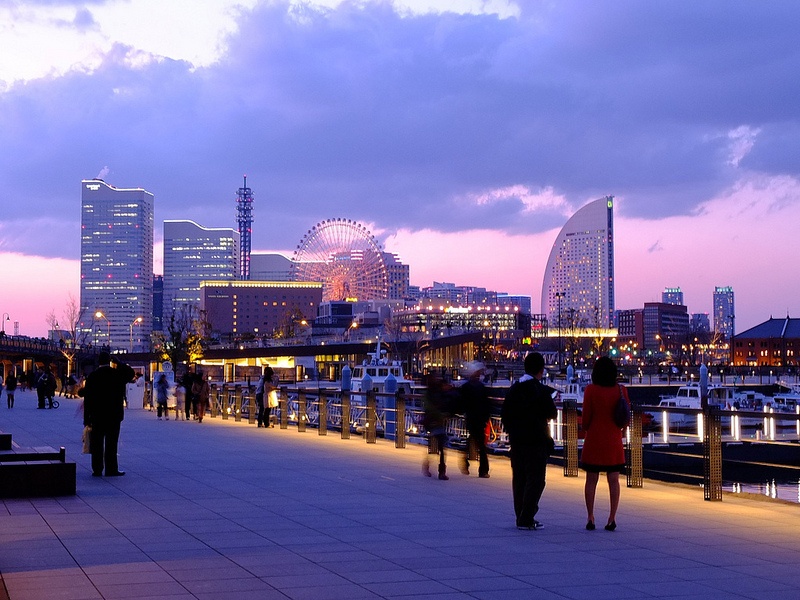
Minatomirai is Yokohama’s purpose-built waterfront district: high-rise towers, shopping complexes, the Landmark Tower, the Ferris wheel, and bay views that feel deliberately cinematic. It is where Yokohama looks most like the city its tourism materials describe. For foreign residents who want a complete urban environment within walking distance of everything — and are willing to pay for it — Minatomirai delivers.
Rent: 1K from approximately ¥100,000–¥150,000 / 1LDK from ¥190,000–¥350,000
Commute: Minato Mirai Line to Yokohama Station in 4 minutes. Yokohama to Shibuya approximately 25 minutes via Tokyu Toyoko Line.
Who it suits: Corporate transferees on housing allowances, foreign professionals relocating with families who want a fully serviced, foreigner-familiar environment from day one, and anyone who values waterfront living and will use it daily rather than as a weekend backdrop.
The foreigner-acceptance rate in Minatomirai buildings is among the highest in Kanagawa. The area was designed with international residents in mind, and the landlord pool reflects that institutional history.
Chinatown / Motomachi / Kannai 中華街・元町・関内 — Maximum international infrastructure
The area connecting Yokohama’s Chinatown, the Motomachi shopping street, and the Kannai business district is where the city’s historical international character is most concentrated. Yokohama’s Chinatown is the largest in Japan — not a tourist attraction that functions as a restaurant cluster, but a genuine residential and commercial community with its own institutional depth. The surrounding streets have international grocery access, multilingual services, and the social infrastructure that makes relocation genuinely easier in the first months.
Rent: 1K from approximately ¥80,000–¥100,000 / 1LDK from ¥130,000–¥230,000 / 2LDK from ¥180,000–¥350,000
Commute: Ishikawacho or Kannai Station to Yokohama Station in 5 minutes. JR Negishi Line to Sakuragicho, then Tokyu to Shibuya in approximately 30 minutes total.
Who it suits: Foreign residents who want an established international community immediately around them, families seeking proximity to Yokohama International School and the area’s international schooling infrastructure, and anyone who values walking-distance access to the kind of food, community, and daily life that feels familiar.
The Motomachi shopping street has maintained its Western-influenced character since the 19th century and is genuinely pleasant to walk — not in a tourist-zone way, but in the way a well-maintained commercial street in a city that takes its own character seriously tends to be.
Yamate / Bluff 山手 — The historic hillside residential district
Yamate is where Yokohama’s 19th-century foreign settlement established its residential base, and the hillside character has persisted in a way that is rare in Japanese cities. The area has quiet, tree-lined streets, Western-style houses alongside Japanese architecture, two major international schools within the district — the British School in Japan (Yokohama campus) and Yokohama International School — and an established expat community that has existed in one form or another since the city’s opening.
Rent: 1K from approximately ¥80,000–¥120,000 / 1LDK from ¥160,000–¥240,000 / House 3BR from ¥600,000–¥850,000
Commute: Yamate Station (JR Negishi Line) to Yokohama Station approximately 10 minutes. Yokohama to Shibuya approximately 30 minutes.
Who it suits: Families relocating with children who need proximity to international schooling, foreign residents who want a quiet, established residential character rather than a high-density urban environment, and anyone who has lived in Japan before and knows they want space and greenery rather than convenience density.
The rent premium in Yamate reflects the international school proximity directly — proximity to the British School or YIS adds a meaningful floor to rental prices that disappears quickly as you move further into Yokohama’s residential interior.
Honmoku 本牧 — Spacious, car-friendly, historically American
Honmoku’s character is shaped by its history as the former US military base area. Wide streets, houses with gardens, a layout that reflects American suburban planning logic rather than Japanese urban density — and as a result, a neighborhood that functions very differently from most residential options in the greater Tokyo area. The international community here has historically centered on US military personnel and their families, and the infrastructure that generates — English-friendly shops, Western-format grocery options, residential spaces genuinely designed for households with children and cars — remains.
Rent: House 3BR from approximately ¥500,000–¥700,000 / House 4BR+ from ¥700,000–¥1,500,000 (apartments limited in this area)
Commute: Car or bus to Yokohama Station approximately 20 to 30 minutes depending on traffic. Less practical for daily Tokyo commutes without a car.
Who it suits: Families relocating with significant housing allowances who want space and garden access, US military community members and families familiar with the area’s infrastructure, and corporate transferees for whom commute time is secondary to residential quality.
Honmoku is the outlier in Yokohama’s foreigner rental landscape — it requires a car, it is not walking-distance to major rail access, and the price point is in a different tier entirely. For the right household profile, however, it offers a residential experience that simply does not exist anywhere closer to central Tokyo at any price.
Yokohama Station area / Nishi-ku 横浜駅周辺・西区 — Best all-round practical base
The neighborhoods immediately around Yokohama Station — Nishi-ku and the surrounding mid-range residential areas — are where the practical argument for Yokohama becomes most legible for most foreign residents. The station itself is one of the major rail hubs in the Kanto region, with JR lines, the Tokyu Toyoko Line, the Sotetsu Line, Keikyu, and the subway all passing through. The surrounding area has the commercial density of a genuine city center without the premium of Minatomirai, and the residential streets within a 10-minute walk of the station offer apartment options at mid-range prices with serious transit access.
Rent: 1K from approximately ¥65,000–¥85,000 / 1LDK from ¥100,000–¥160,000 / 2LDK from ¥140,000–¥230,000
Commute: Direct access to Shibuya (25 min), Shinjuku (30 min), Tokyo Station (25–30 min). Among the most transit-connected locations in the greater Kanto area.
Who it suits: Single professionals and couples who want maximum commute flexibility, foreign residents who are commuting into Tokyo regularly and want to minimize door-to-door journey time while keeping rent below Tokyo ward levels, and anyone who wants to be within walking distance of everything without paying Minatomirai prices.
The Yokohama Station area also has the most practical daily infrastructure — grocery options, restaurants covering most price points, the full retail density a daily life requires — in a format that works without a car.
Totsuka / Hodogaya / Izumi-ku — The residential interior for maximum value
Further into Yokohama’s residential interior, the areas around Totsuka, Hodogaya, and the Izumi-ku corridor along the Sotetsu Izumino Line offer a genuinely different calculation for foreign residents whose priority is apartment space and monthly savings over proximity to Yokohama’s waterfront character.
Rent: 1K from approximately ¥55,000–¥72,000 / 1LDK from ¥75,000–¥105,000 / 2LDK from ¥95,000–¥145,000
Commute: Totsuka to Yokohama Station approximately 15 minutes on JR Yokosuka Line. Izumi-chuo to Yokohama Station approximately 30 minutes on the Sotetsu Izumino Line.
Who it suits: Families and couples who want maximum apartment size at minimum price, remote workers and hybrid workers who do not commute daily, and anyone planning a longer-term stay in Yokohama who wants to optimize monthly costs over time.
These areas are also notably well-stocked with the large-format supermarkets and home improvement stores that make a longer-term residential life functional in a way that dense urban neighborhoods cannot always provide.
What foreign residents should know before renting in Yokohama
Yokohama’s foreigner acceptance is genuinely above average. The city’s history as an international port has produced a landlord pool with decades of experience processing foreign applications. In the established expat areas — Minatomirai, Chinatown, Yamate, and around Yokohama Station — the friction that characterizes foreigner rental applications in less-traveled Japanese cities is significantly reduced. Outside those zones, the standard requirements apply, but even there the baseline attitude is more practiced.
International school proximity is a direct rent variable. The cluster around Yamate and Motomachi, within reach of Yokohama International School and the British School’s Yokohama campus, carries a premium that reflects parental demand. If schooling logistics are part of the housing calculation, the premium is real and the proximity is worth pricing honestly before ruling out the area on rent figures alone.
The commute math depends heavily on which Tokyo you need. Yokohama’s access to southern and western Tokyo — Shibuya, Shinjuku, Osaki, Shinagawa — is excellent. Access to northeastern Tokyo — Ueno, Akihabara, Asakusa — requires either a transfer at Shibuya or a longer journey. Before committing to a Yokohama base for a Tokyo commute, map the specific route to the specific destination. The aggregate picture is favorable, but individual cases vary.
Yokohama is a city, not a suburb. This is worth stating plainly for anyone whose mental model of “cheaper than Tokyo” implies a compromise in urban quality. Yokohama has its own entertainment, cultural, and food infrastructure that functions entirely independently of Tokyo. The waterfront is genuinely world-class. The Chinatown is the best in Japan. The restaurant density across price points is serious. Choosing Yokohama is not choosing less city — it is choosing a different city.
Yokohama in 2026: What has shifted
The remote and hybrid work shift that has restructured the commute calculation for Chiba applies equally to Yokohama. A two-to-three day in-office schedule makes the 25-minute Tokyu Toyoko journey to Shibuya a trivial factor. For the days at home, a Minatomirai bay view or a quiet Yamate hillside street is not a consolation for missing Tokyo — it is a better working environment by most measures.
Corporate relocation to Yokohama has also accelerated, driven in part by office cost differentials with central Tokyo and in part by the city’s genuine international infrastructure. The bilingual services, international schools, and English-capable medical facilities that corporate HR departments require for international employee relocation are available in Yokohama in a depth that is not matched outside of Tokyo itself.
The net effect is a city that is attracting more foreign residents across more income levels than it was five years ago — and building the community depth and infrastructure that makes that transition work.
Find your home in Yokohama with Momo Estate
At Momo Estate, our bilingual team supports international residents through the full Kanto rental process — from identifying foreigner-friendly buildings and managing guarantee company requirements, through contract support and move-in coordination.
We work with landlords and property networks across the Yokohama and Kanagawa market, and we handle the process steps that create the most friction for foreign applicants: application screening, contract translation, and building the case that gets your application approved rather than quietly declined.
Whether you are arriving in Japan for the first time, relocating within the Kanto area, or expanding a long-term property portfolio southward, we are here at every step.
📞 03-6820-6203 📧 info@momoestate.jp 🌐 momoestate.jp